
Mercedes E Class Alignment Specs: Ultimate Performance
Your Mercedes E-Class alignment specs are crucial for optimal handling, tire wear, and a smooth ride. Correct alignment ensures your luxury sedan performs at its peak, delivering the legendary Mercedes-Benz driving experience.
Imagine gliding down the road in your Mercedes-Benz E-Class, feeling that perfect balance of power and comfort. It’s a sensation many of us cherish. But sometimes, that feeling can be compromised by subtle issues: a steering wheel that isn’t quite straight, a slight pull to one side, or uneven tire wear. These are often signs that your wheel alignment might be off. For many E-Class owners, understanding and maintaining the correct alignment specs isn’t just about aesthetics; it’s about preserving the core performance and integrity of their beloved vehicle. Don’t worry if this sounds technical; we’re here to demystify it. This guide will walk you through everything you need to know about Mercedes E-Class alignment specs, ensuring your car drives as perfectly as the day it left the factory.
Why Mercedes E-Class Alignment Specs Matter for Ultimate Performance

Your Mercedes-Benz E-Class is engineered for precision. Its sophisticated suspension system is designed to provide an unparalleled driving experience – smooth, stable, and responsive. Wheel alignment plays a critical role in achieving this. When your wheels are not aligned to factory specifications, a cascade of issues can occur, detracting from that signature Mercedes-Benz feel and potentially leading to more significant problems.
The Core Components of Wheel Alignment
Wheel alignment refers to the angles of your wheels relative to the road and to each other. There are three primary angles we adjust:
- Camber: This is the inward or outward tilt of the tire when viewed from the front. Positive camber means the top of the tire tilts outward, while negative camber means it tilts inward. Properly set camber ensures even tire contact with the road during cornering.
- Caster: Caster is the angle of the steering axis when viewed from the side. Positive caster helps with steering stability and self-centering the steering wheel. It contributes to that confident, straight-line stability you expect from a Mercedes.
- Toe: Toe refers to the angle of the tires when viewed from above, looking down on the car. If the front edges of the tires are closer together than the rear edges, it’s “toe-in.” If the rear edges are closer, it’s “toe-out.” Correct toe settings are vital for steering response and preventing tire scrub.
The Impact of Misalignment on Your E-Class
When your E-Class’s alignment falls outside the manufacturer’s specified range, you might notice several undesirable effects:
- Uneven Tire Wear: This is one of the most common and costly consequences. Misaligned wheels can cause tires to wear out prematurely on the edges, the inside, or in a feathered pattern, reducing their lifespan significantly.
- Poor Handling and Steering: A car that pulls to one side, wanders, or feels unstable in corners is often suffering from alignment issues. This compromises your confidence behind the wheel.
- Compromised Fuel Economy: When tires are not rolling straight, they create more drag, forcing your engine to work harder and reducing your miles per gallon.
- Increased Strain on Suspension Components: Continual misalignment puts undue stress on your steering and suspension parts, potentially leading to premature wear and more expensive repairs down the line.
- Reduced Driving Comfort: That signature smooth Mercedes ride can be dulled by vibrations or a steering wheel that’s off-center, diminishing the luxury experience.
Maintaining the precise Mercedes E-Class alignment specs is not just about preventative maintenance; it’s about safeguarding the engineered performance and luxury that define your vehicle.
Finding Your Specific Mercedes E-Class Alignment Specs

Mercedes-Benz, like any meticulous manufacturer, provides detailed alignment specifications for each model and generation of the E-Class. These specs are not universal; they take into account the vehicle’s weight distribution, suspension design, and intended driving characteristics.
Where to Find the Official Specifications
The most accurate source for your specific E-Class alignment specifications is always the manufacturer’s official documentation. These include:
- Owner’s Manual: While less common for detailed alignment specs, some manuals might offer general guidance.
- Service Manuals: The official Mercedes-Benz workshop manuals are the definitive source. These are typically found in dealerships or can be purchased by enthusiasts.
- Dealership Service Departments: Your local Mercedes-Benz dealership has access to the latest technical data and software that accurately identifies your car’s specifications.
- Professional BMW Alignment Shops: Reputable independent shops specializing in Mercedes-Benz vehicles also have access to these databases.
Key Factors Influencing Alignment Specs
It’s important to understand that alignment specifications can vary slightly based on several factors:
- Model Year: Different generations and even specific years within a generation might have updated or revised specifications.
- Chassis Code: Mercedes E-Class has had various chassis codes (e.g., W123, W124, W210, W211, W212, W213). Each has a unique set of specifications.
- Optional Equipment: Sometimes, specific suspension packages or performance options can influence the alignment targets.
For the purpose of this guide, we will provide typical alignment specifications for a recent E-Class generation (W213). However, it is paramount that you verify these with your vehicle’s specific VIN via a dealer or a qualified independent specialist.
Typical Mercedes E-Class Alignment Specs (W213 Generation – Example)

These figures are approximate and should be confirmed for your exact vehicle. Alignment is typically measured in degrees, with most modern alignments using very small, precise values. Values are often expressed as a range, and the goal is to have the adjusted measurement fall within that optimal range.
Note: Front and rear specifications will differ. When getting an alignment, ensure the technician is performing a four-wheel alignment.
Front Axle
| Parameter | Specification (Degrees) | Notes |
|---|---|---|
| Camber (Driver Side) | -0.75° to -0.25° | Slight negative camber is common for better cornering. |
| Camber (Passenger Side) | -0.75° to -0.25° | Should be matched within 0.5° of the driver’s side. |
| Total Camber | -1.25° to -0.50° | The sum of both sides. |
| Caster (Driver Side) | +7.6° to +8.6° | Contributes to steering stability. |
| Caster (Passenger Side) | +7.6° to +8.6° | Should be matched within 0.5° of the driver’s side. |
| Total Caster Cross | Max 0.5° | Difference between sides. |
| Toe-in/Toe-out (Total) | 0.08° to 0.28° (Toe-in) | Slight toe-in is typical for front wheels for stability. |
Rear Axle
| Parameter | Specification (Degrees) | Notes |
|---|---|---|
| Camber (Driver Side) | -1.50° to -1.00° | Slightly more negative camber in the rear for stability. |
| Camber (Passenger Side) | -1.50° to -1.00° | Should be matched within 0.5° of the driver’s side. |
| Total Camber | -3.00° to -2.00° | The sum of both sides. |
| Toe-in/Toe-out (Total) | 0.10° to 0.30° (Toe-in) | Slight toe-in at the rear helps with straight-line tracking. |
| Thrust Angle | Max 0.15° | The rear axle should be pointed straight ahead. |
These figures highlight the precision engineering involved. Even subtle deviations can impact performance and tire life. For the most accurate and up-to-date data, always consult your vehicle’s specific service information.
When Do You Need an Alignment Check?
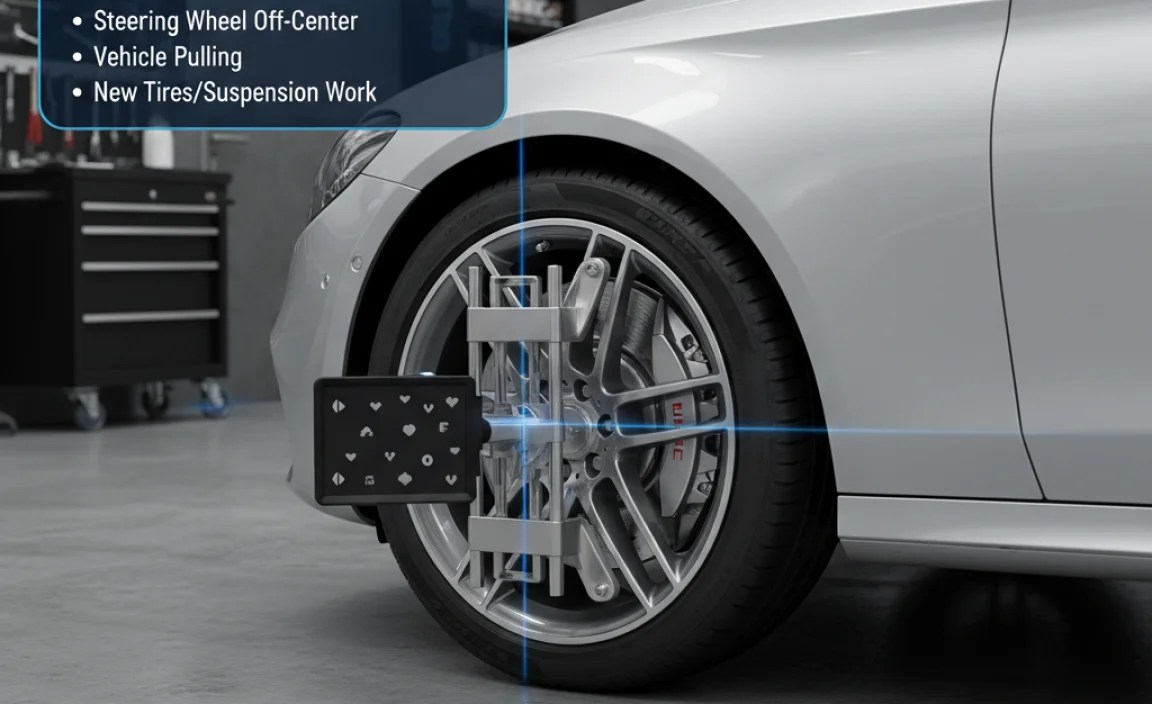
Regular alignment checks are an essential part of maintaining your Mercedes E-Class. While it’s wise to have it checked periodically, certain indicators signal that an immediate inspection is necessary.
Signs Your Mercedes E-Class Needs an Alignment
- Steering Wheel Not Centered: If your steering wheel isn’t straight when you’re driving on a level road, your alignment is likely off.
- Vehicle Pulling to One Side: If your car consistently drifts to the left or right, even when you aren’t turning, it’s a classic symptom of poor alignment.
- Uneven Tire Wear: Inspect your tires for excessive wear on one edge, the inside, or a “feathered” appearance across the tread.
- Squealing Tires: Tires squealing during normal turns can indicate that they are being forced to scrub against the road due to misalignment.
- Vibrations: While vibrations can stem from many issues, sometimes they can be a symptom of alignment problems, especially if they are felt through the steering wheel.
- Recent Incident: If you’ve hit a significant pothole, curb, or been involved in an accident, your alignment should be checked as soon as possible to prevent further damage.
Recommended Maintenance Intervals
Mercedes-Benz generally recommends having your alignment checked:
- Annually: As part of your regular service schedule.
- Every 10,000 miles: Or sooner if you notice any of the symptoms above.
- After Tire Replacement: New tires are an investment, and proper alignment will help them last longer.
- After Suspension Work: Any work done on components like shocks, struts, ball joints, or control arms will affect alignment.
Think of alignment checks as a small preventative measure that safeguards your vehicle’s performance and your investment in tires and suspension components. It’s a key step in ensuring that celebrated Mercedes E-Class driving dynamic remains intact.
The Alignment Service Process Explained

Understanding what happens during a professional wheel alignment can make the process less mysterious and help you appreciate the precision involved. It’s a multi-step process that requires specialized equipment and expertise.
Step 1: Initial Inspection and Diagnosis
Before adjustments are made, a qualified technician will perform a thorough inspection:
- Visual Inspection: They’ll check for obvious damage to tires, wheels, and suspension components.
- Test Drive: To assess handling characteristics, steering feel, and identify any pulling or wandering issues.
- Tire Condition Check: To document any existing uneven wear patterns.
Step 2: Mounting the Vehicle on the Alignment Rack
The vehicle is driven onto a specialized alignment rack. This rack has multiple lift points to ensure the car is level and stable. For modern, sophisticated vehicles like the E-Class, a “drive-on” rack is preferred over a rack that requires jacking the vehicle significantly, as jacking can sometimes compress suspension components and alter readings.
Step 3: Installing Wheel Targets
Special optical targets or sensors are attached to each wheel. These are precisely calibrated to communicate with the alignment machine’s computer system.
Step 4: Taking Initial Measurements
The alignment machine uses cameras and sensors to measure the current angles of your wheels (camber, caster, and toe) relative to the vehicle’s centerline and the ground. This data is displayed on a computer screen, comparing your car’s current angles to the factory-specified Mercedes E-Class alignment specs.
Step 5: Adjusting the Alignment
This is where the actual adjustments are made. The technician will loosen specific adjustment bolts or cams within the suspension system and then carefully turn them to bring each angle within the manufacturer’s specified range. This process requires a delicate touch and a deep understanding of the Mercedes-Benz suspension geometry.
- Toe Adjustment: Typically adjusted by turning tie rod ends.
- Camber Adjustment: Often adjusted by eccentric bolts or by moving control arms. On some vehicles, special shims might be used, or control arm bushings can be replaced.
- Caster Adjustment: Usually adjusted in conjunction with other components, often involving eccentric cams or by rotating specific suspension parts.
Step 6: Verifying the Adjustments
Once adjustments are made, the technician re-measures all angles to ensure they now fall within the Mercedes E-Class alignment specs. This process is repeated until all angles are correct.
Step 7: Final Check and Documentation
The technician checks that all adjustment points are securely tightened. You’ll typically receive a printout showing the “before” and “after” alignment readings, along with the factory specifications, so you can see the corrections made.
A proper alignment is an art and a science, requiring the right tools, up-to-date data, and skilled technicians. It’s an investment that pays dividends in ride quality, tire life, and driving confidence.
DIY Alignment vs. Professional Service
For many luxury car owners, the question arises: can I do this myself, or is professional service the only way to go?
DIY Alignment Considerations
While the allure of DIY is strong, especially for enthusiasts, performing a full, accurate wheel alignment on a Mercedes E-Class is generally not recommended for several reasons:
- Specialized Equipment: Professional alignment requires a sophisticated computerized alignment rack, specialized measuring tools, and calibration equipment. Basic string-and-tape methods are insufficient for modern, complex suspension systems.
- Precise Specifications: As we’ve seen, Mercedes E-Class alignment specifications are very precise and often require fine adjustments measured in fractions of a degree. Reading and achieving this level of accuracy without professional gear is extremely difficult.
- Suspension Complexity: Modern Mercedes suspensions feature complex geometries, sometimes with multiple adjustment points. Understanding how to adjust each component without disrupting others requires specialized knowledge and experience.
- Safety: Incorrect alignment can lead to unpredictable handling, reduced tire grip, and increased risk of accidents.
- Cost-Effectiveness: The cost of purchasing the necessary professional-grade equipment would far outweigh the cost of professional service.
The Benefits of Professional Alignment Services
Opting for a professional alignment offers several key advantages:
- Accuracy: State-of-the-art equipment ensures precise measurements and adjustments to meet Mercedes E-Class alignment specs.
- Expertise: Trained technicians understand the intricacies of Mercedes-Benz suspension systems and have access to up-to-date factory data.
- Efficiency: While it takes time, professionals can typically perform an alignment more efficiently due to their experience and equipment.
- Warranty: Reputable shops offer warranties on their alignment services, providing peace of mind.
- Comprehensive Inspection: During an alignment, technicians can often identify other potential suspension or steering issues that you might otherwise miss.
- Ride Quality Guarantee: A professional alignment aims to restore optimal handling and a smooth, comfortable ride.
For a vehicle as sophisticated and performance-oriented as a Mercedes E-Class, entrusting your alignment to qualified professionals is the surest way to guarantee that its engineering potential is fully realized and maintained. You can learn more about vehicle maintenance best practices from organizations like the National Highway Traffic Safety Administration (NHTSA), which provides valuable information on tire safety and vehicle maintenance.
Maintaining Your E-Class for Optimal Alignment
Beyond professional alignment services, there are several things you can do as an owner to help maintain your E-Class’s alignment and ensure its long-term performance.
Driving Habits and Road Conditions
- Avoid Potholes and Obstacles: The most common cause of alignment issues is impact. Drive cautiously, especially on roads with poor surfaces.
- Be Mindful of Curbs: Parking maneuvers, especially sharp turns, can inadvertently bump wheels against curbs, knocking alignment out of spec.
- Proper Tire Inflation: While not directly


