
Mercedes E Class Battery Reset: Ultimate Power
Quick Summary: A Mercedes E Class battery reset is a straightforward process that can resolve minor electrical glitches and optimize battery performance. It typically involves disconnecting and reconnecting the battery terminals. This guide provides clear, step-by-step instructions for safely performing this reset on your E Class, restoring its “ultimate power.”
Have you ever experienced a peculiar electrical hiccup in your Mercedes E Class? Perhaps a dashboard light flickered unexpectedly, or a system seemed a little sluggish? Often, these minor gremlins can be easily fixed with a simple procedure: a Mercedes E Class battery reset. It’s a surprisingly effective trick that many E Class owners can perform themselves. This process essentially gives your car’s electrical system a fresh start, clearing out temporary glitches and recalibrating its various modules. We’ll walk you through exactly why this works and how to do it safely, ensuring your E Class is back to its optimal, powerful self in no time. Let’s get your Mercedes running smoothly again!
What is a Mercedes E Class Battery Reset?

At its core, a Mercedes E Class battery reset, often referred to as a “hard reset” or “ECU reset,” is the process of temporarily disconnecting the vehicle’s battery, thereby cutting power to all electronic modules. This interruption forces the car’s computers and control units to re-initialize and re-learn their operating parameters when power is restored. Think of it like restarting your computer when an application isn’t behaving correctly – it clears temporary memory and refreshes the system.
This procedure is particularly useful for resolving minor electronic anomalies. Modern Mercedes-Benz vehicles, including the E Class, are packed with sophisticated electronics that communicate constantly. Sometimes, through normal operation, software quirks, or minor power fluctuations, these systems can get out of sync. A battery reset can effectively clear these temporary errors without needing a professional diagnostic scan in many cases.
Why Perform a Battery Reset?

Several indicators might suggest that a battery reset could be beneficial for your Mercedes E Class:
- Intermittent Electrical Issues: If you notice random warning lights appearing and disappearing, or minor systems like infotainment or power windows acting erratically.
- “Check Engine” Light (Mild Cases): While it usually signifies a more significant issue, a persistent “Check Engine” light that clears after a driving cycle might be resolved by a reset if it was triggered by a transient sensor reading. However, always consult a professional if the light returns.
- After Battery Replacement: New batteries can sometimes cause initial communication issues with the car’s modules. A reset helps the car recognize and adapt to the new power source.
- Sluggish Performance: Occasionally, electronic modules coordinating engine or transmission behavior can get stuck in an inefficient state. A reset can prompt them to re-optimize.
- Troubleshooting Complex Problems: Before delving into more complex diagnostics, a battery reset is a simple, non-invasive first step to rule out common electronic glitches.
It’s important to remember that a battery reset is not a fix for mechanical failures or major diagnosed electrical faults. It’s a tool for resolving temporary software or communication glitches within the electronic control units (ECUs).
When a Battery Reset is NOT the Solution

While a battery reset can fix many minor issues, it’s crucial to understand its limitations. It will NOT resolve:
- Mechanical Failures: Problems with the engine, transmission, brakes, or suspension are physical issues that require mechanical repair.
- Serious Electrical Faults: Persistent warning lights related to critical systems (e.g., ABS, SRS airbags, drivetrain malfunction) often indicate a deeper problem that needs professional diagnosis.
- Software Corruption: If a specific module’s software is corrupted, a simple power cycle may not be enough; a software reflash by a dealer or specialist might be necessary.
- Physical Battery Damage: If the battery itself is physically damaged, leaking, or has corroded terminals, it needs replacement, not just a reset.
If you are experiencing significant performance issues or critical warning lights, it’s always best to consult a qualified Mercedes-Benz technician. You can find authorized service centers through the official Mercedes-Benz USA website or by contacting their customer support.
Safety Precautions Before You Start

Working with a car battery involves handling electricity, so safety is paramount. Before you begin the Mercedes E Class battery reset, please take these precautions:
- Ensure the Vehicle is Off: The engine must be completely off, and the key removed from the ignition.
- Locate a Safe Area: Park your E Class on a level surface in a well-lit and well-ventilated area. Avoid doing this in damp conditions.
- Wear Protective Gear: Always wear safety glasses to protect your eyes from potential sparks or battery acid. Gloves are also recommended to keep your hands clean and protected.
- Understand the Risks: While generally safe, static electricity discharge or improper handling can damage sensitive electronics. Proceed with care.
- Know Your Battery Type: Most modern Mercedes E Class models use AGM (Absorbent Glass Mat) batteries, which are sealed and maintenance-free. Do not attempt to open or add water to these.
- Have the Radio Code Ready: Disconnecting the battery can reset your car radio and may require you to enter a security code to restore its functionality. Consult your owner’s manual or dealership if you don’t have this code readily available.
Tools You Will Need
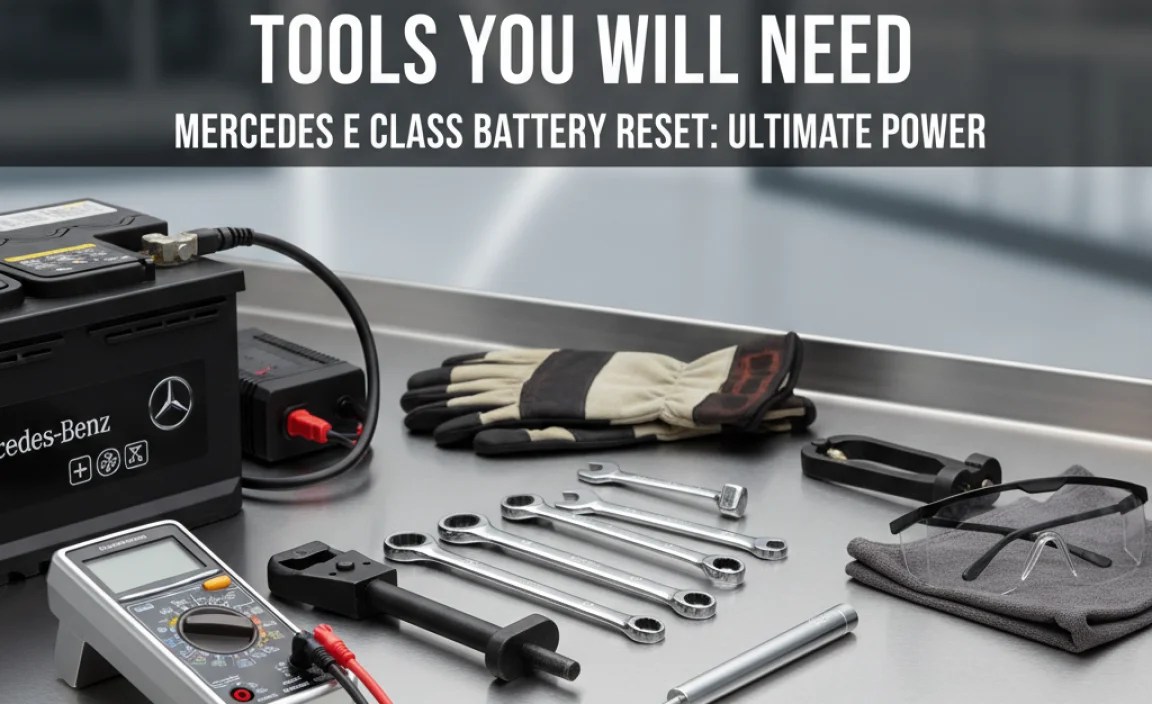
Fortunately, performing a battery reset on your Mercedes E Class doesn’t require specialized, exotic tools. You’ll likely have most of what you need in a home toolkit. Here’s a list of essentials:
- Socket Wrench Set: You’ll need sockets that fit the battery terminal nuts. Common sizes for Mercedes are typically 10mm or 13mm, but it’s best to have a range.
- Wrench Extensions: These can be helpful to reach the battery terminals if they are recessed.
- Wire Brush or Battery Terminal Cleaner: To remove any corrosion from the battery terminals and cable clamps. Clean terminals ensure good electrical contact.
- Gloves: To protect your hands.
- Safety Glasses: Essential eye protection.
- A Rag or Towel: To keep things clean.
Finding the Battery in Your E Class
The location of the battery can vary slightly depending on the E Class model year (W212, W213, etc.). In many modern E Class models, the primary battery is located in the trunk, often on the right or left side, concealed behind a panel or cover.
- Open the Trunk: Use your key fob or the release lever inside the car.
- Locate the Access Panel: Look for a removable panel on the side wall of the trunk. You might need to remove some carpeting or trim pieces to access it. It’s often secured by clips or a simple latch.
- Reveal the Battery: Once the panel is removed, you should see the battery itself. Some models may also have a smaller auxiliary battery in the engine bay, but the main reset procedure typically involves the primary battery.
If you’re unsure, your Mercedes-Benz E Class owner’s manual is the definitive guide for locating your specific model’s battery.
Step-by-Step: How to Reset Your Mercedes E Class Battery
Performing a Mercedes E Class battery reset is a relatively simple DIY task. Follow these steps carefully:
Step 1: Prepare the Vehicle
- Ensure the engine is off and has been for at least 15-30 minutes to allow systems to power down.
- Remove the key from the ignition and ensure all doors are closed.
- Access the battery as described in the “Finding the Battery” section.
Step 2: Disconnect the Negative Terminal
- Locate the battery terminals. You’ll see a positive (+) terminal and a negative (-) terminal. The negative terminal typically has a black cable and is often marked with a minus (-) sign.
- Using your socket wrench, loosen the nut on the clamp holding the negative cable to the battery post.
- Once loose, gently twist and pull the negative cable clamp upwards to lift it off the battery post. Do not let it touch any metal part of the car or the positive terminal.
- Let the negative cable rest aside, ensuring it is not in contact with the battery post.
Step 3: Disconnect the Positive Terminal (Optional, but Recommended for a Full Reset)
- Now, locate the positive (+) terminal (usually red).
- Loosen the nut on the clamp holding the positive cable.
- Carefully lift the positive cable clamp off the positive battery post.
- Again, ensure it does not touch any metal.
Note: Resetting only the negative terminal is sometimes sufficient to reset memory modules. However, for a more complete system reset, disconnecting both is often performed. If you are hesitant about disconnecting the positive terminal, start with just the negative.
Step 4: Discharge Residual Power
- With both terminals (or at least the negative) disconnected, press and hold the brake pedal for about 30 seconds. This helps to discharge any residual power remaining in the car’s capacitors and electronic modules.
- You can also touch the disconnected positive and negative cables together (briefly and carefully!) for a few seconds. This is a common method to ensure all residual power is drained. Ensure you only touch the metal parts of the clamps, not the rubber insulation, and that neither is connected to the battery.
Step 5: Wait and Reconnect
- Leave the terminals disconnected for 15-30 minutes. This waiting period allows the car’s onboard computers to fully power down and reset.
- Clean the battery posts and cable clamps with a wire brush or terminal cleaner if you see any signs of corrosion. Clean contacts are vital for optimal performance.
- Reconnect the positive terminal clamp first, ensuring it is seated firmly on the post. Tighten the nut securely.
- Reconnect the negative terminal clamp, again ensuring a firm connection and secure tightening of the nut.
Step 6: Start the Vehicle and Relearn
- Once both terminals are securely reconnected, close the trunk.
- Insert the key into the ignition and start the engine.
- The engine may start a bit rougher than usual, or idle slightly differently as the engine control unit (ECU) begins to relearn parameters. This is normal.
- Some warning lights might briefly illuminate and then turn off.
- You may need to drive the vehicle for 10-20 minutes on city streets and highways to allow various systems (like transmission, power steering, and idle control) to recalibrate fully.
- Your radio may ask for a code. If so, enter it.
Congratulations! You’ve successfully performed a Mercedes E Class battery reset.
What to Expect After the Reset
After a successful battery reset, you should notice a few positive changes. Minor electrical glitches that were present before should subside. Dashboard warning lights that were intermittent or falsely triggered should disappear. The car’s systems may feel smoother and more responsive. For example, the transmission might shift more smoothly, and the idle might be more stable after the relearn period.
Keep in mind that the car’s computers will need a short period to re-adapt to your driving style and the vehicle’s specific operating conditions. This is why a short drive is often recommended.
Performance Impact and Considerations
A Mercedes E Class battery reset primarily aims to restore proper electronic function, which indirectly impacts perceived performance. By clearing minor glitches, you can regain the smooth power delivery and responsiveness that your E Class is known for. It’s not a performance upgrade in the traditional sense—it won’t add horsepower—but it restores the car to its intended operational state. Think of it as bringing your symphony orchestra back into perfect tune.
For those with E Class AMG models, this reset helps ensure that the highly tuned engine and dynamic suspension systems are communicating and operating optimally. While AMG power is inherent, electronic harmony is crucial for unleashing its full potential.
Battery Maintenance Best Practices
To minimize the need for frequent resets and ensure the longevity of your E Class battery, consider these maintenance tips:
- Regular Inspection: Periodically check the battery terminals for corrosion. Clean them with a wire brush and a battery terminal cleaner solution if necessary. You can find excellent automotive cleaning supplies at reputable auto parts stores like AutoZone or Advance Auto Parts.
- Ensure Proper Connection: Make sure battery terminals are always tightly secured. Loose connections can cause intermittent electrical problems.
- Monitor Warning Lights: Don’t ignore persistent warning lights. While a reset might temporarily clear them, it’s crucial to diagnose the underlying cause with a professional if they return.
- Consider a Battery Tender: If your E Class is often parked for extended periods, a battery tender (also known as a trickle charger) can help maintain the battery’s charge and prevent it from discharging too deeply, which can damage the battery. Reputable brands include CTEK and BatteryMINDer.
- Professional Testing: Have your battery tested annually, especially if it’s more than three years old. Most auto parts stores offer free battery testing services.
Understanding Battery Types in Mercedes E Class
Modern Mercedes E Class vehicles typically use either standard flooded lead-acid batteries or, more commonly, AGM (Absorbent Glass Mat) batteries. Some models also feature an auxiliary battery, usually located in the engine bay, which powers comfort features like the start-stop system.
AGM Batteries: These are highly efficient, vibration-resistant, and can handle higher electrical loads. They are sealed and maintenance-free. When replacing an AGM battery, it’s crucial to use another AGM battery of the correct size and rating to ensure proper system function.
The table below outlines some general characteristics and considerations for Mercedes E Class batteries:
| Battery Type | Typical Location | Key Characteristics | Maintenance & Considerations |
|---|---|---|---|
| Primary Battery (AGM) | Trunk | Sealed, maintenance-free, high cranking amps, deep cycle capability (for start-stop) | Requires specific charging profiles, vent the trunk if it’s a sealed system, ensure proper hold-down. |
| Auxiliary Battery (Often AGM or standard in older models) | Engine Bay | Powers comfort systems, start-stop function, often smaller | May require similar charging considerations as the main battery. Crucial for start-stop functionality. |
For the most accurate information regarding your specific E Class model, always refer to your owner’s manual. Mercedes-Benz often has precise technical requirements for battery charging and replacement, which are critical for the vehicle’s complex electrical system. You can find extensive technical service bulletins and owner’s manuals on official Mercedes-Benz resources, often accessible through their owner portal.
Troubleshooting Common Issues Post-Reset
While a battery reset is usually effective, sometimes minor issues might persist or new ones can appear. Here’s how to approach them:
- Persistent Warning Lights: If a dashboard warning light remains illuminated, the issue is likely not a simple glitch. It’s time to visit a mechanic. They can use an OBD-II scanner (On-Board Diagnostics) or Mercedes-specific diagnostic tools like the Mercedes-Benz Star Diagnostic system (SDS) to read error codes and pinpoint the problem.
- System Malfunctions: If a specific system (like the sunroof, windows, or infotainment) still isn’t working correctly, it might require manual recalibration. Often, this involves a specific sequence of button presses or actions, detailed in your owner’s manual. For example, to reset power windows, you might need to roll them all the


